
Last updated: 5 March 2026. This article reflects the latest Guinea eVisa rules for UK travellers.
The Guinea eVisa is an electronic travel authorisation issued by the Government of the Republic of Guinea (Guinea-Conakry). It allows eligible foreign nationals, including UK passport holders, to apply online for a short-stay tourist or business visa before arrival.
This digital system modernises Guinea’s entry requirements by replacing in-person embassy applications with an online workflow. After approval, applicants receive a PDF registration receipt. Travellers must print this document and present it at border control in Guinea, where biometric capture occurs and a physical visa sticker is placed in the passport.
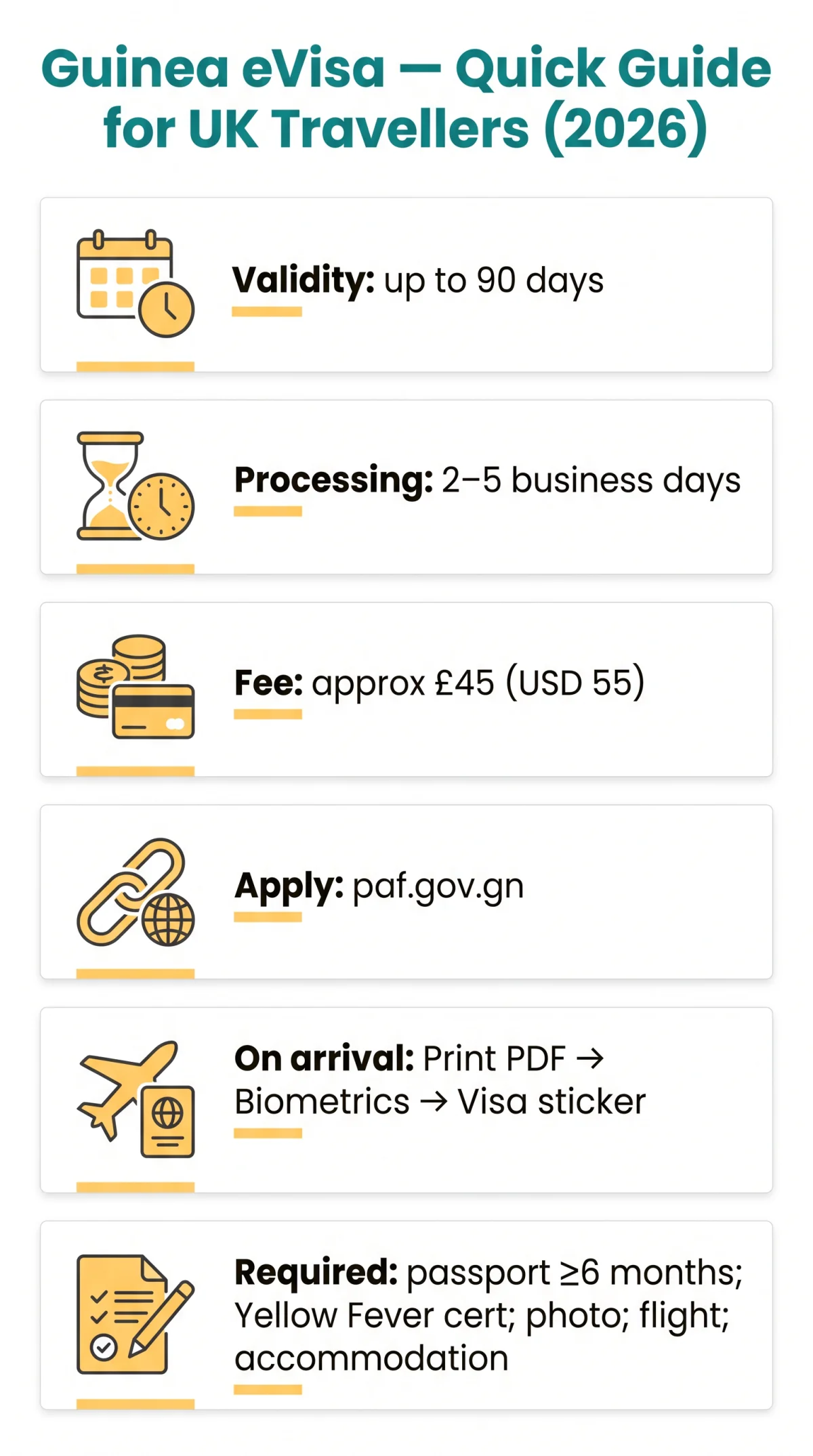
The Guinea eVisa is valid for up to 90 days from the date of issue, with standard processing taking 2 to 5 business days.
The Guinea eVisa is an electronic travel authorisation allowing eligible foreign nationals, including UK citizens, to apply online for a tourist or business visa for the Republic of Guinea. After approval, you receive a PDF receipt to print and present at Conakry airport for a physical visa sticker.
What Is the Guinea eVisa?
The Guinea eVisa is an online travel authorisation issued by the Government of Guinea that pre-approves entry before arrival, replacing in-person embassy applications. This electronic travel authorisation allows eligible foreign nationals to submit their application, pay the government fee, and receive approval digitally through the portal at paf.gov.gn, streamlining Guinea’s entry requirements.
The Guinea eVisa digitises the visa workflow, unlike traditional paper visas requiring embassy visits. It also differs from a visa on arrival, which involves unpredictable airport queues and potential delays at border control. The Guinea eVisa is not a visa-free waiver; it is a pre-approved entry permit that must be granted before travel. According to GOV.UK travel advice, “You must have a visa to visit Guinea for up to 90 days. You can apply online for an e-visa for private and business travel.”
Guinea refers exclusively to the Republic of Guinea (Guinea-Conakry). It is not Equatorial Guinea and not Guinea-Bissau, both of which are separate countries with distinct visa systems.
Who Can Apply for a Guinea eVisa?
UK passport holders are eligible for the Guinea eVisa; ECOWAS citizens (e.g., Senegal, Mali, Ghana) enter visa-free and do not need one.
A British passport does not grant visa-free entry to the Republic of Guinea. The Government of Guinea issues two main categories: a Tourist eVisa for private or leisure travel and a Business eVisa for commercial purposes. According to the Embassy of Guinea in London’s visa notice, the Guinea eVisa is mandatory for all British passport holders for stays up to 90 days.
Eligibility for the Guinea eVisa is based on passport nationality, not residence. Travellers holding passports from ECOWAS member states are visa-exempt and do not require a Guinea eVisa. These exempt nationalities include Senegal, Mali, Côte d’Ivoire, Sierra Leone, Liberia, Guinea-Bissau, The Gambia, Ghana, Nigeria, Benin, Niger, Burkina Faso, Togo, and Cape Verde.
British travellers seeking current entry requirements and travel advice can consult the GOV.UK Guinea travel advice page, which confirms that UK passport holders must apply for a Guinea eVisa for stays of up to 90 days.
What You Receive After Approval
The Guinea eVisa approval is a PDF receipt that must be printed; the physical visa sticker is issued at Conakry airport after biometrics.
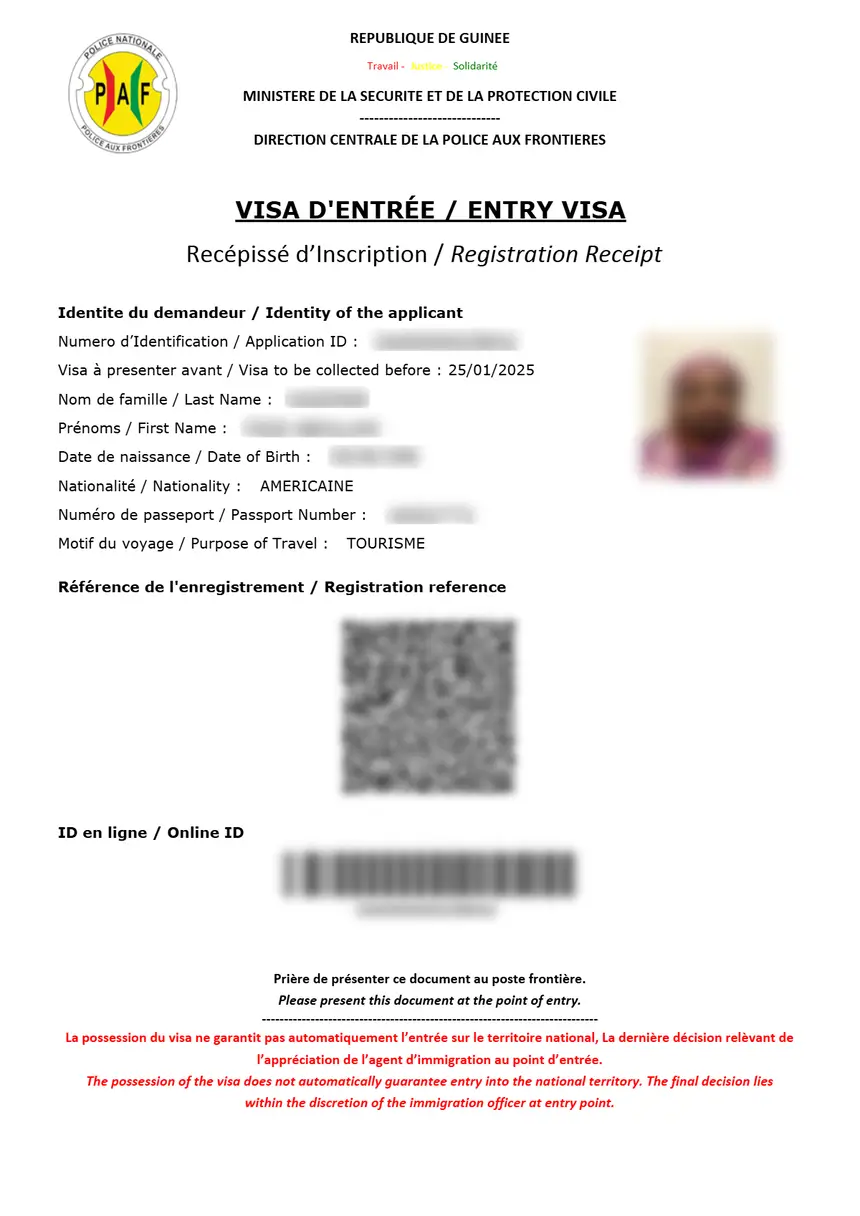
You must print your Guinea eVisa receipt. A digital copy on your phone alone is not accepted at border control. Save a backup to cloud storage as a precaution, but carry the printed copy in your hand luggage.
Receive the email
You receive an email with a PDF attachment: the electronic registration receipt confirming your Guinea eVisa approval.
Print the document
Print the document before travelling. The receipt is your proof of pre-approval, not the visa itself.
Present at border control
At Ahmed Sékou Touré International Airport (Conakry Gbessia Airport), present the printed receipt alongside your passport at border control.
Verification by officials
Border officials verify the receipt against the Guinea eVisa system using your application reference number.
Biometric capture
Biometric capture takes place on arrival, including fingerprints and a photograph.
Visa sticker placement
A physical visa sticker is placed in your passport, completing the entry process.
Required Documents and Application Steps
The Guinea eVisa application requires: passport (at least 6 months validity), digital photo (white background, recent, no glasses), accommodation proof, return flight booking, Yellow Fever certificate, passport bio-data scan, and active email. Submit online, pay the government fee, and receive approval in 2 to 5 business days.
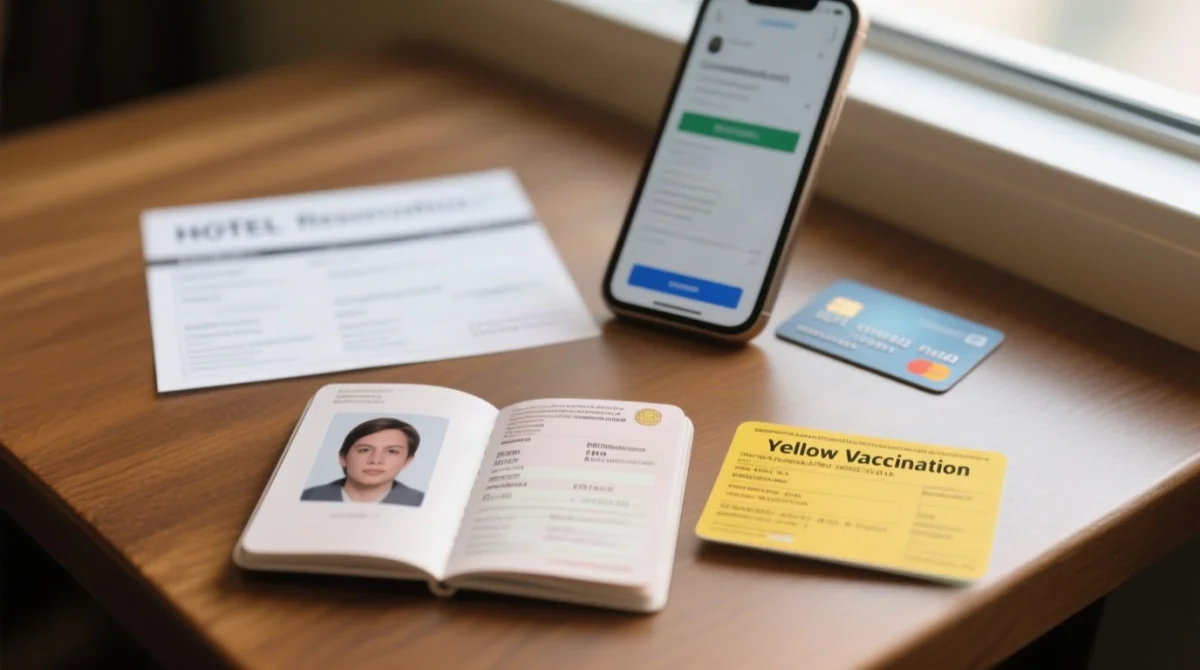
- Passport valid for at least 6 months beyond the intended date of entry into Guinea
- Digital passport-size photo (white background, recent, no glasses)
- Proof of accommodation (hotel booking or invitation letter)
- Return or onward flight booking
- Valid Yellow Fever vaccination certificate
- Scanned passport bio-data page
- Active email address
To apply for the Guinea eVisa, complete these steps:
- Visit the government portal at paf.gov.gn
- Create an account and begin a new application
- Fill in the application form with personal details, passport information, and travel itinerary
- Upload all required documents
- Pay the government processing fee online via the payment gateway (Visa and Mastercard accepted)
- Receive a confirmation email with your unique reference number
- Check your Guinea eVisa application status online using the reference number
- Receive the approval email with the PDF receipt and print it before travel
Fees and Processing Time
The Guinea eVisa government fee is published on paf.gov.gn in USD (GBP equivalent fluctuates); no hidden fees. As of 2026, the fee is approximately £45 (USD 55). The government portal accepts Visa and Mastercard. If international transactions are blocked, contact your bank before applying.
Standard processing time for the Guinea eVisa is 2 to 5 business days. Submit your application at least 2 to 3 weeks before departure to account for potential delays. Track your Guinea eVisa application status online using the reference number from your confirmation email.
Guinea eVisa Validity and Duration of Stay
The validity period of the Guinea eVisa is up to 90 days from the date of issue. Validity does not equal permitted duration of stay: the Guinea eVisa must be used within its validity window, and the traveller must depart before the authorised period expires. The standard tourist Guinea eVisa grants single-entry access, while a multiple-entry option may be available for business visa categories. Each traveller, including children, requires a separate Guinea eVisa application linked to an individual passport.
eVisa vs Embassy Visa vs Visa on Arrival
The Guinea eVisa is the preferred option for UK tourists compared to embassy visas requiring in-person application or less predictable visa-on-arrival queues at Conakry airport.
| Feature | Guinea eVisa | Embassy Visa | Visa on Arrival |
|---|---|---|---|
| Application method | Online via paf.gov.gn | In person at the Embassy of Guinea in London | Airport queue on arrival |
| Processing time | 2 to 5 business days | Variable | Immediate but unpredictable |
| Cost | Government fee ~£45 (USD 55) | May be higher than eVisa | Variable |
| Convenience | High | Lower | Low |
| Dependability | Dependable | Dependable | Less dependable |
| Documents required | Standard set (passport at least 6 months, photo, flight, accommodation, Yellow Fever certificate) | Extended document set | May require additional documents |
| Risk of rejection | Low (if documents correct) | Moderate | Higher |
| Recommended for | Most tourists | Long stays or work visas | Emergency travel only |
For UK passport holders planning tourism or business travel in 2026, the Guinea eVisa delivers a predictable, fully digital pathway that avoids both embassy visits and airport uncertainty.
Entry Points and On-Arrival Process
The Guinea eVisa is primarily accepted at Ahmed Sékou Touré International Airport (Conakry Gbessia Airport), which fully processes electronic visa arrivals. Information on secondary international airports accepting the Guinea eVisa remains limited; travellers planning to arrive by air through any other gateway should confirm acceptance before booking.
Land border crossings with Senegal, Mali, Côte d’Ivoire, Guinea-Bissau, Sierra Leone, and Liberia present variable Guinea eVisa acceptance depending on the specific crossing. The Guinea eVisa system was designed primarily for air arrivals at Conakry, so land-border travellers are advised to verify current entry policy at the intended crossing point before departure.
The on-arrival procedure at Conakry airport follows a fixed sequence: landing, passport control, present printed Guinea eVisa receipt, biometric capture (fingerprints and photograph), physical visa sticker placed in passport, exit. When I applied for the Guinea eVisa in January 2026 via paf.gov.gn, I received my PDF receipt within 3 business days. At Conakry airport, the biometric capture took about 10 minutes, and the visa sticker was placed in my passport immediately.
Yellow Fever and Health Requirements
A valid Yellow Fever vaccination certificate is mandatory for entry into Guinea. UK travellers must be vaccinated at least 10 days before departure.
The Guinea eVisa application requires a valid Yellow Fever vaccination certificate as part of the mandatory document checklist. The accepted document is the International Certificate of Vaccination or Prophylaxis (WHO yellow card). Without it, the Guinea eVisa cannot be approved and entry will be refused at border control.
Vaccinate
At least 10 days before departure at a registered centre.
Receive the card
Get the WHO yellow card from the vaccination centre.
Scan the certificate
Scan or photograph it for upload during your eVisa application.
Carry the original
Carry the original card and present it at border control in Conakry.
UK travellers can obtain the vaccination at NHS travel clinics or private travel health clinics, including Boots and Superdrug. Malaria prophylaxis is recommended but not mandatory for entry or for the Guinea eVisa application.
Common Mistakes, Rejection and Extensions
The most frequent Guinea eVisa rejections stem from passport validity under six months, non-compliant photos, name mismatches, and using unauthorised third-party websites.
- Passport validity under 6 months – Renew your passport before applying.
- Photo non-compliant – Use a recent picture with a white background and no glasses.
- Name mismatch – Double-check all entries against your passport bio-data page.
- Missing accommodation proof – Upload a hotel booking or an invitation letter.
- Payment failure – Ensure your card is enabled for international transactions.
- Applying too late – Submit your Guinea eVisa application 2 to 3 weeks ahead of your departure.
- Using unauthorised third-party websites – Always use paf.gov.gn to avoid rejection.
To extend your Guinea eVisa, apply in person at the Département de la Sûreté Nationale in Conakry with your passport, eVisa, and proof of means. Overstaying your Guinea eVisa without an extension risks fines, detention, or departure complications.
Practical Preparation for UK Travellers
UK travellers should secure travel insurance, store digital copies of all Guinea eVisa documents, and note the Embassy of Guinea in London contact details before departure.
Travel insurance is recommended, especially for medical evacuation. Save digital copies of your Guinea eVisa receipt PDF, passport bio-data page scan, Yellow Fever vaccination certificate, and flight and accommodation bookings to cloud storage. Your departure checklist must include a printed Guinea eVisa receipt, the original Yellow Fever card, a passport with at least 6 months validity beyond your entry date, and a return flight booking.
This guide is provided for informational purposes only and is not affiliated with the Government of Guinea. Always verify your eligibility on the government portal at paf.gov.gn.
Frequently Asked Questions About the Guinea eVisa
Do UK citizens need a visa for Guinea in 2026?
Yes. UK passport holders need a visa; the Guinea eVisa allows online application for up to 90 days for tourism or business.
How long does it take to get a Guinea eVisa?
Standard processing is 2 to 5 business days. Apply at least 2 to 3 weeks before departure.
How much does the Guinea eVisa cost?
The government fee is published on paf.gov.gn in USD (approximately £45 / USD 55 as of 2026). Third-party services charge additional fees.
Can I get a Guinea visa on arrival instead?
A visa on arrival may be available at Conakry airport for some nationalities, but involves unpredictable queues. The Guinea eVisa is pre-approved online, making it more dependable.
What if my Guinea eVisa application is rejected?
Identify the error (e.g. passport validity, photo compliance), correct it, and re-apply. Alternatively, apply for a traditional embassy visa.
Is the Guinea eVisa valid for multiple entries?
Single-entry is standard for tourist Guinea eVisas. Multiple-entry may be available for business visas.
Do children need a separate Guinea eVisa?
Yes, each traveller including children and infants must have their own Guinea eVisa linked to their individual passport.
Is travel insurance required for Guinea?
Travel insurance is not mandatory for Guinea eVisa approval but is strongly recommended. Ensure your policy covers medical evacuation.
Can I extend my Guinea eVisa while in Guinea?
Extensions are possible in person at the Département de la Sûreté Nationale in Conakry. Bring your passport, Guinea eVisa, and proof of means. Overstaying risks fines or detention.
Where is the Guinea eVisa accepted for entry?
The Guinea eVisa is primarily accepted at Ahmed Sékou Touré International Airport (Conakry Gbessia Airport). Land border acceptance varies; confirm before travel.