

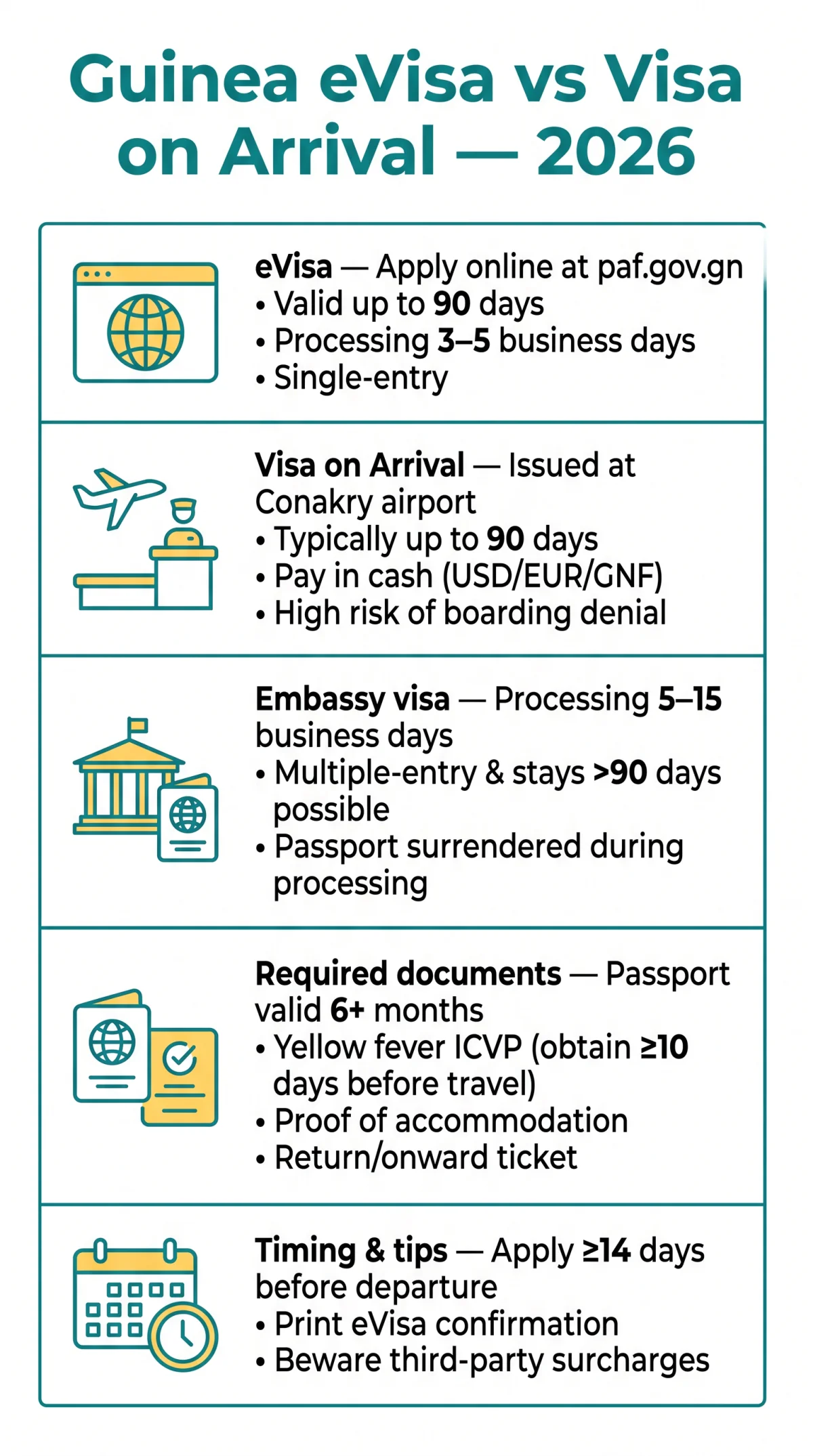
What is the difference between a Guinea eVisa and a visa on arrival? A Guinea eVisa is a pre-approved electronic visa valid for up to 90 days, applied for online before departure via the paf.gov.gn portal. A visa on arrival is obtained at Conakry airport upon landing, but carries a real risk of airline boarding denial. For UK tourists, the Guinea eVisa is the safer route in 2026.
Below: Guinea eVisa vs visa on arrival vs embassy visa – application method, cost, processing time, documents.
Understanding Guinea’s Visa Options: eVisa, Visa on Arrival, and Embassy Visa
The Guinea eVisa is an electronic visa available to UK passport holders through the paf.gov.gn portal. It is valid for 90 days, single-entry, for private and business travel, with a 3-5 business day turnaround. Entry is permitted at Ahmed Sékou Touré International Airport in Conakry and select land borders.
A visa on arrival is riskier: airlines may deny boarding without pre-approved documentation. It is obtainable at Conakry airport for certain nationalities, but UK citizens face refusal risk without a Guinea eVisa or equivalent pre-approved document.
The traditional embassy visa, issued by the Guinean Embassy in London, requires in-person or postal submission with passport surrender during processing. Turnaround takes 5-15 business days, and suits travellers needing multiple entries or stays exceeding 90 days.
Guinea eVisa vs. Visa on Arrival: A Detailed Comparison
- Pre-approved certainty before departure
- Faster immigration – skip-the-queue, pre-cleared
- No passport surrender during processing
- Online application via paf.gov.gn
- Low risk of boarding denial
- Processing time of 3-5 business days (not immediate)
- Single-entry only
- Validity limited to 90 days
- Land border availability may vary
| Attribute | Guinea eVisa | Visa on Arrival |
|---|---|---|
| Application method | Online via paf.gov.gn before travel | At Conakry airport immigration counter |
| Pre-travel requirement | Pre-approved document required | None – apply at border |
| Processing time | ~3-5 business days | Immediate (queue-dependent) |
| Cost | Government fee on paf.gov.gn | Cash at counter (USD/EUR/GNF) |
| Validity | Up to 90 days, single-entry | Typically up to 90 days |
| Convenience | Skip-the-queue; pre-cleared | No pre-arrangement; queue at border |
| Risk | Low (pre-approved) | High (boarding denial possible) |
Processing Time Comparison
Guinea eVisa: approximately 3-5 business days via paf.gov.gn. Embassy visa: 5-15 business days. Visa on arrival: immediate at counter, but queue length varies. Apply at least 2 weeks before departure to avoid missed flights.
Cost Breakdown
Government fee for the Guinea eVisa: check current fee on paf.gov.gn (subject to change). Visa on arrival fee: paid at counter in USD, EUR, or Guinean franc (GNF). Embassy visa: consular fee payable in GBP to the Guinean Embassy in London. Third-party agent surcharges can significantly increase costs compared to applying directly.
Required Documents for Guinea’s Visa Routes
All Guinea visa routes require a passport valid for at least 6 months from date of entry (passport validity is a strict entry requirement), proof of accommodation, and a mandatory yellow fever vaccination certificate (ICVP). The Guinea eVisa system requires applicants to upload digital copies of supporting documents via the paf.gov.gn portal before travel, whereas the visa on arrival and embassy routes rely on physical documents presented in person.

| Document | Guinea eVisa | Visa on Arrival | Embassy Visa |
|---|---|---|---|
| Valid passport (6+ months) | ✓ | ✓ | ✓ |
| Passport-sized photo | ✓ (digital upload) | ✓ (physical) | ✓ (physical) |
| Return/onward ticket | ✓ | ✓ | ✓ |
| Proof of accommodation | ✓ | ✓ | ✓ |
| Yellow fever ICVP (mandatory) | ✓ | ✓ | ✓ |
| Sponsor/invitation letter | May be required | May be required | May be required |
| Printed eVisa confirmation | ✓ | ✗ | ✗ |
| Physical passport surrender | ✗ | ✗ | ✓ |
The Guinea eVisa eliminates passport surrender during processing, unlike the embassy route where the passport is held for 5-15 business days. UK travellers should obtain the yellow fever ICVP at least 10 days before departure, as it is checked at immigration regardless of visa type. For current entry requirements and health advice, consult the GOV.UK travel advice for Guinea and the WHO yellow fever country requirements.
Costs, Processing Times, and Payment Methods
Fees: Guinea eVisa paid by card on paf.gov.gn; visa on arrival in cash (USD/EUR/GNF); embassy visa in GBP to the Guinean Embassy in London.
The Guinea eVisa system processes applications within approximately 3 to 5 business days through the paf.gov.gn portal, where payment is made by international credit or debit card. The current government fee is listed on the portal at the time of application, as pricing is subject to change. A traditional embassy visa takes 5 to 15 business days, with the consular fee payable in GBP. A visa on arrival is issued immediately at the Conakry airport immigration counter, though wait times depend on queue length, and the fee must be paid in cash: either USD, EUR, or Guinean franc (GNF).
Frequently Asked Questions (FAQ)
Is the Guinea eVisa valid at land borders or only at Conakry airport?
The Guinea eVisa is accepted at Ahmed Sékou Touré International Airport and select land crossings. Availability at land borders may vary, so confirm before overland travel.
How long does it take to get a Guinea eVisa?
Approximately 3 to 5 business days via paf.gov.gn. Apply at least 2 weeks before departure.
Can I get a visa on arrival in Guinea Conakry?
Yes, certain nationalities can obtain one at Conakry airport. UK citizens may be eligible, but a Guinea eVisa is strongly recommended to avoid boarding denial.
How much does a Guinea eVisa cost for UK citizens?
Check the current fee on paf.gov.gn; agents add surcharges.
Do I need a yellow fever vaccination certificate for Guinea?
Yes, a yellow fever ICVP is mandatory for all visa types and is checked at immigration. Obtain it at least 10 days before departure.
Can I extend my Guinea eVisa after arriving?
Extensions may be possible through the DCPAF in Conakry, but are not guaranteed and fees apply. Plan within the original 90-day validity.
Do I need to give biometric data when entering Guinea with an eVisa?
Upon arrival, Guinea eVisa holders typically receive a Visa Volant sticker and may have biometric data (fingerprints and photo) taken at the immigration counter.
Is the Guinea eVisa system reliable for UK travellers in 2026?
Operational; apply early and carry a printed Guinea eVisa confirmation.