

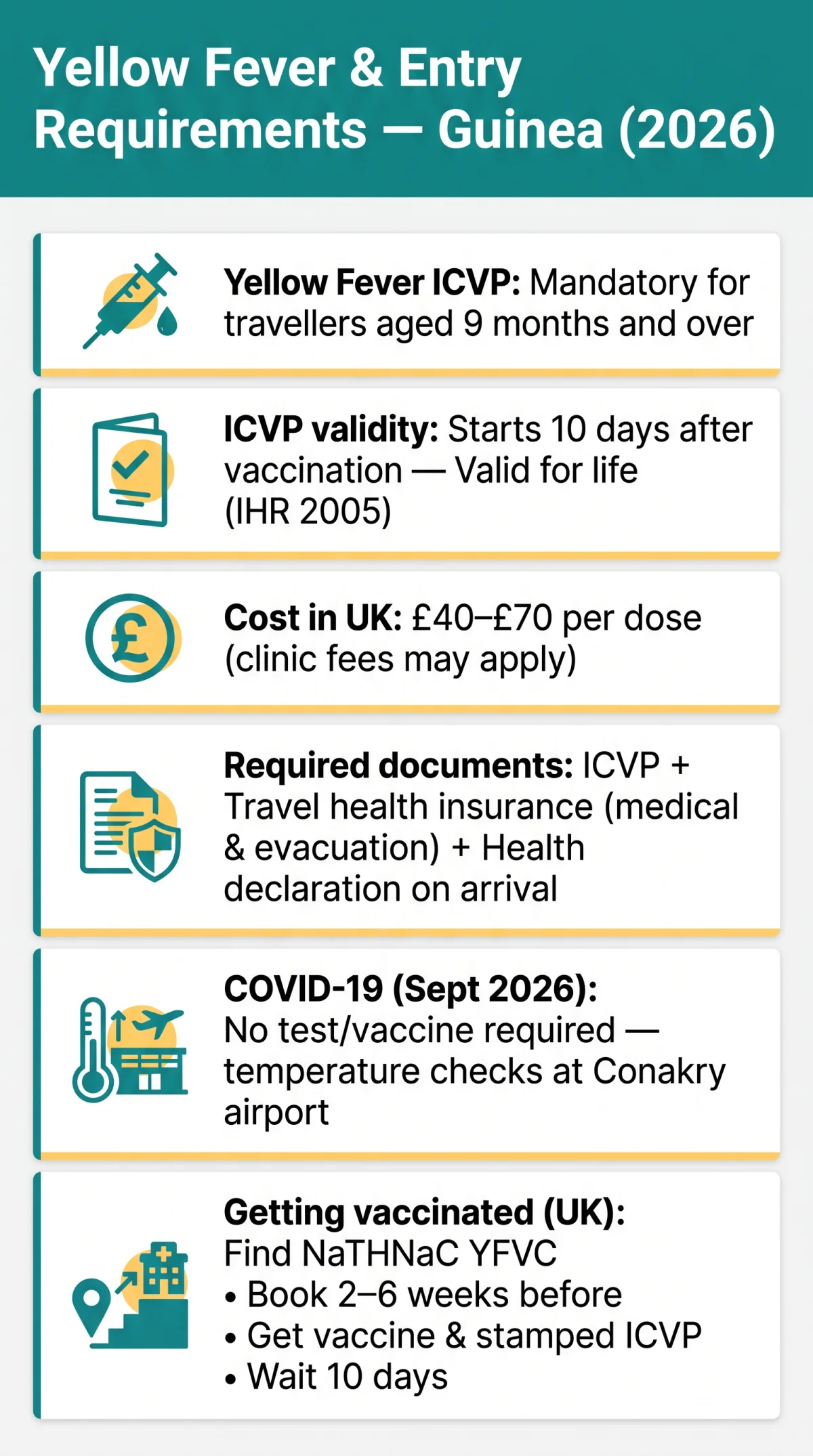
Do I need a yellow fever vaccine for Guinea? Yes. Guinea requires all travellers aged 9 months and over to hold a valid International Certificate of Vaccination or Prophylaxis (ICVP) for entry. The vaccine must be administered at least 10 days before arrival, and mandatory health insurance documentation is also required for the Guinea eVisa application.
The ICVP must be issued at a registered Yellow Fever Vaccination Centre (YFVC) and presented at border control upon arrival in Guinea. This requirement applies to all travellers regardless of itinerary, as the entire country lies within a yellow fever endemic zone where the risk of yellow fever transmission exists across all regions.
As of September 2026, Guinea does not require COVID-19 testing or vaccination proof for entry. However, COVID-19 health screening, including temperature checks and a health declaration form, remains in place at Ahmed Sékou Touré International Airport in Conakry.
All Health Entry Requirements for Guinea at a Glance (2026)
Guinea mandates a yellow fever ICVP, proof of vaccination, mandatory travel insurance, and a completed health declaration form at the border. The yellow fever vaccination requirement for Guinea applies to all travellers aged 9 months and over, enforced at every port of entry as a border entry requirement.
| Document | Status | What You Need | Notes |
|---|---|---|---|
| Yellow Fever ICVP | Mandatory | WHO-standardised yellow booklet issued at a registered YFVC | Valid 10 days after administration; lifelong validity |
| COVID-19 proof | Not required | No testing or vaccination certificate needed | As of September 2026 |
| Health Insurance | Mandatory | Policy covering medical treatment and emergency evacuation | Required for eVisa application and at border |
| Health declaration form | Required | Completed on arrival at airport | Temperature checks remain at Conakry Airport |
| Malaria prophylaxis | Recommended | Atovaquone-proguanil, doxycycline, or mefloquine | High risk year-round; not enforced at border |
Last verified: September 2026. Sources: WHO International Travel and Health, NaTHNaC Country Profile for Guinea, gov.uk travel advice.
Yellow Fever Certificate Requirements for Guinea
Guinea requires a valid ICVP for all travellers aged 9 months and over, enforced at border control regardless of itinerary.
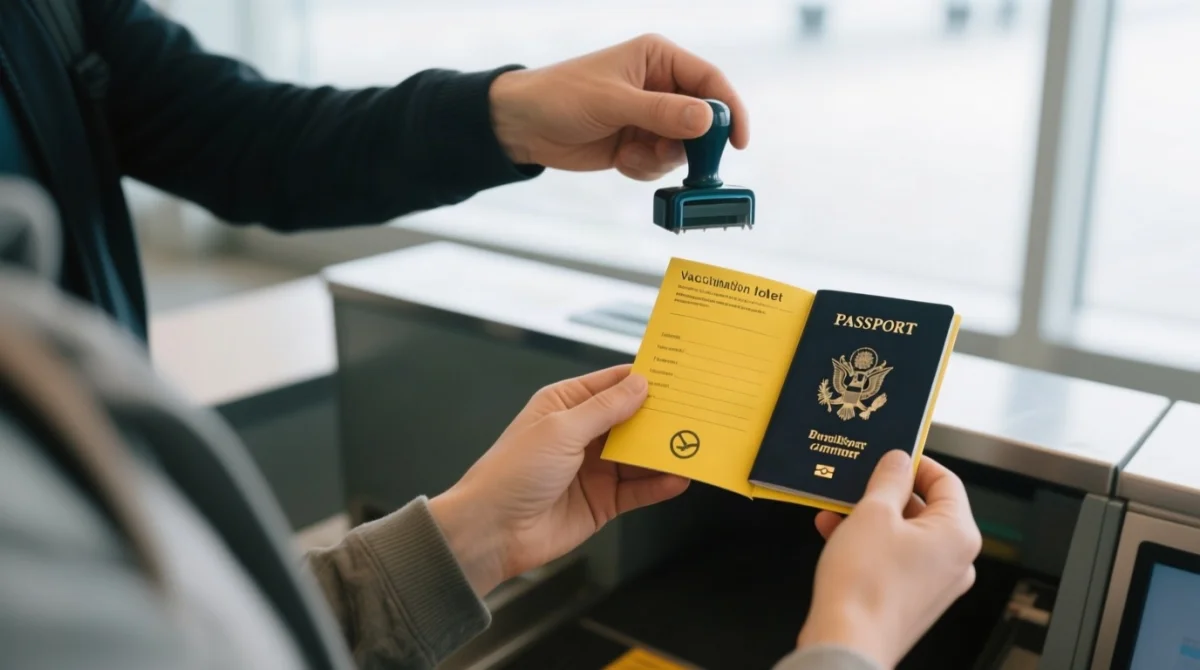
The requirement applies across all regions (WHO-classified endemic zone); border officers inspect the ICVP at every port of entry and may deny boarding or admission without it. The risk of yellow fever transmission exists countrywide, including Conakry, due to Aedes aegypti mosquito presence in urban settings.
Critical: The ICVP becomes valid 10 days after primary vaccination.
The ICVP is a WHO-standardised yellow booklet issued only at registered YFVCs, containing your name, vaccine batch number, date, stamp, and authorised signature. NHS printouts are not accepted. Under IHR 2005, the certificate is valid for life; no 10-year booster is required. The yellow fever vaccination certificate serves as your proof of vaccination at all Guinea border checkpoints.
COVID-19 and Health Insurance Requirements for Guinea (2026)
Guinea lifted mandatory COVID-19 testing and vaccination requirements, but COVID-19 health screening and temperature checks remain at Ahmed Sékou Touré International Airport in Conakry.
As of September 2026, Guinea does not require COVID-19 testing or vaccination proof, but temperature checks and health declaration forms remain at Conakry Airport. Mandatory travel insurance is a border entry requirement for all travellers. You must present proof during the Guinea eVisa application and again at border control. Coverage must include medical treatment, hospitalisation, and emergency medical evacuation. Accepted formats include a paper policy or a digital certificate.
How to Get a Yellow Fever Vaccine in the UK (Including Exemptions)
UK travellers can obtain the yellow fever vaccine at NaTHNaC-registered Yellow Fever Vaccination Centres for approximately £40 to £70 per dose.
Find a registered YFVC
Use the NaTHNaC Yellow Fever Zone directory to find a registered Yellow Fever Vaccination Centre.
Book a travel health consultation
Schedule your appointment 2 to 6 weeks before travel.
Receive the vaccine
A single subcutaneous injection is administered.
Receive the ICVP booklet
Your certificate is stamped, dated, and signed at the clinic.
Wait 10 days
The certificate becomes valid for entry 10 days after vaccination.
| Clinic | Phone | Email / Website |
|---|---|---|
| Superdrug Health Clinic | 0333 311 1007 | Over 90 stores nationwide; £20 consultation fee may apply |
| London Vaccination Clinic | 020 7112 5198 | [email protected] |
| Nomad Travel | 01341 555 061 | [email protected] |
| Passport Health | passporthealthglobal.com (over 300 global locations) |
Guinea’s yellow fever vaccination requirement allows exemptions for immunosuppressed individuals, those with severe egg allergy, infants under 9 months, and pregnant travellers (temporary deferral). A Medical Letter of Exemption (MLE) must be issued by a registered YFVC after clinical consultation, per the NaTHNaC factsheet updated 22 June 2026. Verify MLE acceptance with the Guinea embassy or eVisa portal before departure.
Recommended Vaccinations and Other Health Risks in Guinea
Hepatitis A, typhoid, meningococcal meningitis, and rabies vaccines are recommended but not mandatory for entry into Guinea. Only the yellow fever vaccination certificate is enforced at border control.
- Hepatitis A and B – high prevalence in West Africa
- Typhoid – recommended for all travellers
- Meningococcal meningitis – Guinea lies within the African meningitis belt
- Rabies pre-exposure – for long-stay or rural travellers
- Tetanus-diphtheria booster – routine immunisation check
Malaria: high risk year-round across Guinea; malaria prophylaxis is strongly recommended. Options include atovaquone-proguanil, doxycycline, or mefloquine. Note: mefloquine (Lariam) 250mg shortage continues in the UK as of 9 September 2026, per travelhealthpro.org.uk. Use DEET-based repellent, treated clothing, and bed nets for mosquito bite prevention.
Travel requirements can change at short notice. Check the official UK Foreign, Commonwealth & Development Office (FCDO) travel advice for Guinea before booking.
FAQ: Yellow Fever, COVID-19, and Health Insurance for Guinea
Do UK citizens specifically need a yellow fever certificate for Guinea?
Yes. Guinea requires all travellers aged 9 months and over to present a valid yellow fever vaccination certificate (ICVP) at border control, regardless of nationality. UK citizens are subject to the same entry requirement as all other international arrivals.
Does my old yellow fever certificate still count, or do I need a booster?
Your existing certificate remains valid for life under IHR 2005. Since the 2016 IHR amendment, no 10-year booster is required. Older certificates with a printed 10-year expiry date are still accepted at Guinea’s border.
What happens if I arrive without a yellow fever certificate?
Travellers without a valid ICVP may face on-arrival vaccination, denial of entry, or quarantine. Carry your certificate in hand luggage.
Can I get a yellow fever vaccine at Conakry Airport?
On-arrival vaccination availability at Conakry Airport is not confirmed. Verify with your airline or the Guinea embassy. The safest approach is to obtain your ICVP before departure.
Do I need a certificate if only transiting through Conakry?
Transit exceeding 12 hours may trigger inspection of yellow fever documentation. Verify with your airline before travel. For shorter connections, carrying your ICVP remains advisable.
How long does the vaccine take to become valid?
The ICVP becomes valid 10 days after primary vaccination. Book your consultation at a registered YFVC 2 to 6 weeks before travel to allow adequate time.
What other vaccinations do I need for Guinea?
Hepatitis A, Hepatitis B, Typhoid, Meningococcal meningitis, Rabies pre-exposure, and a Tetanus-diphtheria booster are recommended. Guinea lies within the African meningitis belt. All are recommended, not mandatory for entry. Only the yellow fever vaccination certificate is enforced at border control.
Is health insurance mandatory for entering Guinea?
Yes. Proof of travel health insurance is mandatory during the Guinea eVisa application process and at border control. Your policy must cover medical treatment, hospitalisation, and emergency medical evacuation.
Which African countries do NOT require yellow fever vaccination?
Several African countries without endemic yellow fever risk do not require the certificate for entry. However, Guinea enforces it for all arrivals aged 9 months and over as an endemic zone. Check the WHO country list for current exemptions.
How much does a yellow fever vaccine cost in the UK in 2026?
The yellow fever vaccine costs approximately £40 to £70 per dose at registered YFVCs in the UK. Some clinics may charge an additional consultation fee.